What is Cryptography in Modern Security Systems?
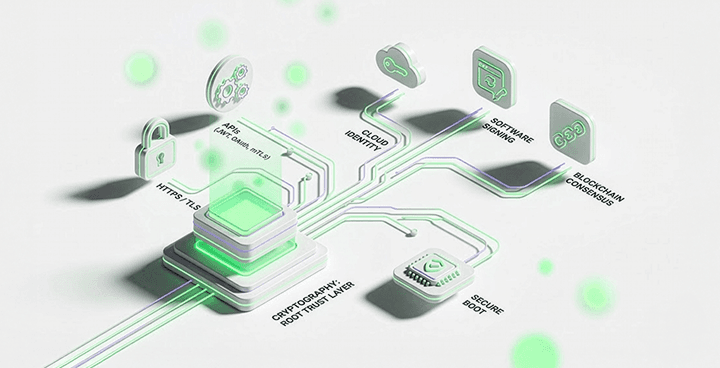
From a cybersecurity perspective, cryptography is not just encryption. It is the root trust layer of nearly all modern digital systems.
Cryptography secures :
- TLS/HTTPS traffic
- API authentication (JWT, OAuth, mTLS)
- Software update signing
- Cloud identity systems
- Blockchain consensus
- Password storage
- Secure boot & firmware integrity
If cryptography fails, all higher-layer security controls fail with it, including firewalls, IAM, and zero-trust architectures.
What is Post-Quantum Cryptography (PQC)?
Post-Quantum Cryptography (PQC) refers to cryptographic algorithms that remain secure even if the attacker has access to a large-scale quantum computer.
Important clarification from a security standpoint:
- PQC does not require quantum hardware
- PQC runs on classical CPUs
- PQC is a defensive response to future attacker capabilities
The goal is cryptographic longevity: data encrypted today must remain secure for decades.
Why Quantum Computing is a Real Cryptographic Threat?
Security professionals do not worry about quantum computing because it is hypothetical.
We worry because:
- Nation-states are funding quantum research heavily
- Cryptographic migration historically takes 10–20 years
- Encrypted data has long-term value
Security is about anticipating attacker capability, not reacting to it.
Background: Mathematical Foundations of Current Encryption
Public-Key Cryptography Today
Most asymmetric cryptography relies on problems that are:
- Hard for classical computers
- Easy to verify
- Assumed to be one-way functions
Examples :
| Algorithm | Mathematical Problem |
|---|---|
| RSA | Integer factorization |
| ECC | Elliptic curve discrete logarithm |
| DH | Discrete logarithm |
These assumptions collapse in the presence of quantum algorithms.
Quantum Algorithms and Cryptographic Collapse
Shor's Algorithm (Critical Threat)
Shor's algorithm allows a quantum computer to:
- Factor large integers efficiently
- Solve discrete logarithms efficiently
Impact :
- RSA → Broken
- ECC → Broken
- ECDSA → Broken
- Diffie-Hellman → Broken
This is not a "weakened" scenario. This is a complete cryptographic failure.
Grover's Algorithm (Moderate Threat)
Grover's algorithm reduces brute-force search complexity from:

This affects:
- Symmetric encryption
- Hash functions
Mitigation:
- AES-256 instead of AES-128
- SHA-384 instead of SHA-256
The "Harvest Now, Decrypt Later" Threat Model
This is the most dangerous and misunderstood quantum threat.
How it works:
- Attacker captures encrypted traffic today
- Stores it indefinitely
- Decrypts it once quantum capability exists
Why This Matters
- Medical records
- Government communications
- Trade secrets
- Legal documents
- Source code
From a cybersecurity risk perspective, encryption expiration dates matter.
Post-Quantum Cryptography Algorithm Families
After years of global cryptanalysis, NIST selected several PQC algorithms.
Key Algorithm Classes :
Lattice-Based Cryptography
- CRYSTALS-Kyber
- CRYSTALS-Dilithium
Security based on:
- Learning With Errors (LWE)
- Module-LWE problems
These problems currently have no known efficient quantum attacks.
Hash-Based Cryptography
- SPHINCS+
Advantages:
- Extremely conservative security assumptions
Disadvantages:
- Large signature sizes
- Slower performance
Code-Based Cryptography
- McEliece (not standardized yet)
Extremely strong but impractical due to massive key sizes.
Security Trade-offs and Performance Considerations
From an operational security standpoint, PQC introduces trade-offs:
| Aspect | Impact |
|---|---|
| Key size | Larger |
| CPU usage | Higher |
| Network overhead | Increased |
| Latency | Slightly higher |
| Memory | Increased |
However, performance is not a security argument when confidentiality requirements span decades.
Migration Strategy for Enterprise
A realistic, security-first migration strategy includes:
Phase 1 – Crypto Inventory
- Identify all cryptographic dependencies
- TLS, JWT, PKI, VPN, SSH, code signing
Phase 2 – Hybrid Cryptography
- Classical + PQC algorithms combined
- Safe fallback if PQC breaks
Phase 3 – Policy & Governance
- Crypto agility
- Certificate lifecycle updates
- Vendor compliance checks
Security teams must treat PQC as risk management, not optional optimization.
Common Misconceptions About PQC
Misconception 1: "Quantum computers don't exist yet"
Reality: Attackers already collect encrypted data.
Misconception 2: "Only governments need PQC"
Reality: Enterprises hold intellectual property worth billions.
Misconception 3: "We can switch algorithms later"
Reality: Cryptographic migration is slow, complex, and fragile.
Misconception 4: "PQC is experimental"
Reality: NIST-standardized algorithms are production-ready.
Conclusion

From a cybersecurity expert's perspective, Post-Quantum Cryptography is not optional, not speculative, and not hype-driven.
It is a response to:
- Predictable attacker evolution
- Long-term data sensitivity
- Historical lessons of cryptographic collapse
Organizations that delay PQC adoption are not saving cost — they are accumulating invisible technical debt with catastrophic risk.
Quantum computing will not announce itself politely. When cryptography breaks, it breaks everywhere at once.
References
- [1]NIST - Post-Quantum Cryptography Project https:
/ / csrc.nist.gov/ projects/ post- quantum- cryptography - [2]NIST - First Quantum-Resistant Cryptographic Algorithm Selection (2022) https:
/ / www.nist.gov/ news- events/ news/ 2022/ 07/ nist- announces- first- four- quantum- resistant- cryptographic - [3]Peter W. Shor (1994) - Algorithms for Quantum Computation https:
/ / arxiv.org/ abs/ quant- ph/ 9508027 - [4]ENISA - Post-Quantum Cryptography: Current State and Quantum Mitigation https:
/ / www.enisa.europa.eu/ publications/ post- quantum- cryptography- current- state- and- quantum- mitigation - [5]Cloudflare Research - Post-Quantum Cryptography for All https:
/ / blog.cloudflare.com/ post- quantum- for- all/